B2B design has a credibility complex. Somewhere along the way, the industry powers that be decided that “serious” categories — finance, industrial manufacturing, data infrastructure, logistics, etc. — earn trust through restraint. Aesthetic ambition is a discretionary spend reserved for brands selling something fun.
The Cost
The result is a landscape of uniformity: navy blue, sans-serif, a stock photo of a handshake, and volumes of people in business suits. The implication is that maintaining the perception of perfection is nine-tenths of the brief, every time. We conflate the regurgitated and robotic with authority and constrain brands to a narrow slip of expression, identity, and connection.
This is not an argument for creativity for the sake of creativity. Or fun for the sake of silliness or shock value. It’s not a demand that we esteem B2B design as an art form on par with the noble Renaissance. It’s a call to recognize the power inherent to design.
Businesses demonstrate their values through their creative. What does a “sea of sameness” communicate?
| Flippancy | Intentionality? | |
| Disconnection from customers | Empathy with end-users? | |
| An aversion to honesty | OR | Transparency about a sometimes-messy reality? |
| A stilted, stagnant culture/product/service | A personable, smart, proactive culture/product/ service? | |
| A lack of belief in your value | Contagious excitement and confidence? |
From an immediate and practical standpoint, the success of the ads we’re spending so much time, energy, and money to create is on the line. Hinging the performance of a multi-figure campaign on stock hand-shaking pictures is, arguably, a cavalier move, but it’s one B2B brands make over and over again.
The Unimportant Origin
For most complex problems, understanding the “why” is often just as important as knowing the “what.” But in this case, the origin of B2B design’s credibility complex is immaterial.
First, because the “why” is likely a gnarly, overwhelming conglomerate of:
-
Evolutionary survival tactics (i.e., the false comfort of conformity)
-
Our ever-growing emphasis on speed and efficiency
-
The approximate 87 stakeholders per campaign (aka “death by committee”)
-
Despondency within the status quo
-
Society norms and power dynamics around “professionalism”
-
Binary thinking
And more immediately, what we need most — what our customers need — is a path out and upward. Or what marketers often call “actionable insights.” Dillydallying over the “why” might be a great way to ragebait on socials, but it’s not an effective means of solving the problem. In fact, focusing on these things is why we haven’t solved it.
The Blame Impediment
It’s alluring to glance around and holler, “This is AI’s fault. The ‘sea of sameness’ is AI slop.” Or to scan our surroundings and scream into the void, “It’s the customers. They’re running scared. They won’t let us do the brave, fun, and smart, but risky-feeling things.”
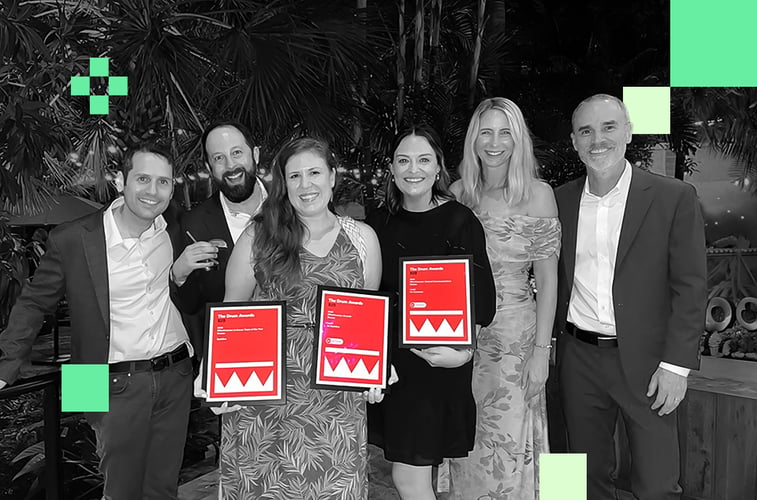
There are two problems with passing the buck, which The Drum’s B2B Editor Reuben Webb nicely sums up:
“A lot of the work we do is very average. The reason there is a lot of average work is there’s a market for it. There’s a market for mediocrity…That phrase ‘sea of sameness’ — I’ve heard that phrase for 25 years in this industry. And, if there’s a sea of sameness created by AI, is it just replacing the sea of sameness we created all along?” (The Creative Machine: Episode 2)
The first bit seems to confirm that the market is the issue. Just how exactly are we supposed to change the market by swimming against the tide? We can’t control other people. They want the safe options.
And the second bit about AI slop is just hurtful. (Because the truth hurts.)
But both points, by extension, lead us to what we’ve been avoiding: There’s only one thing we can control — ourselves. We are the creators of this problem, and we’re the solution to it.
The Answer
Time for some good news. And just like the bad news, it’s staring us in the face.
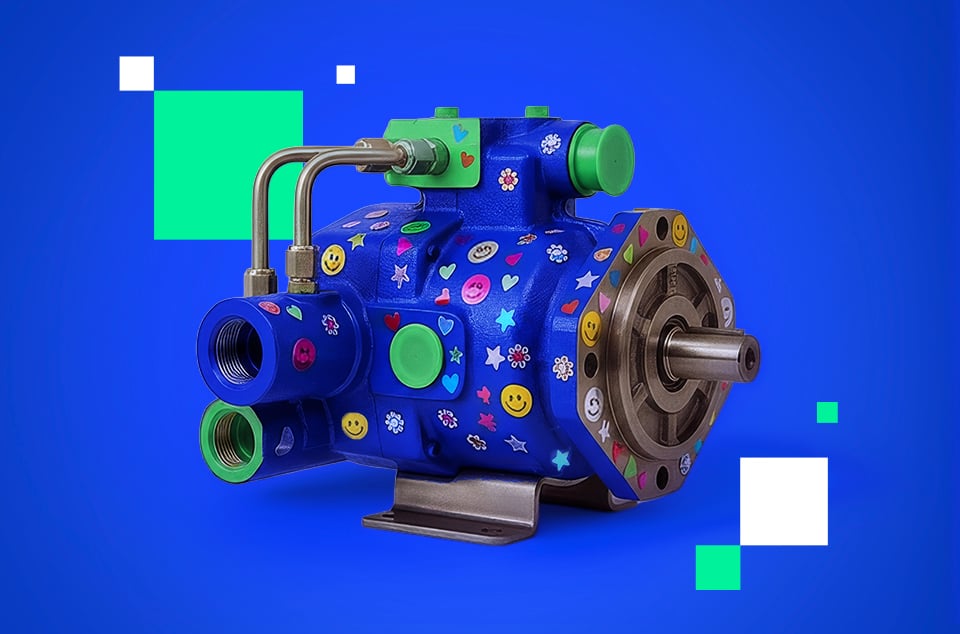
There’s a quiet advantage buried in B2B: the absence of a visual ideal. A skincare brand fights against decades of pastel minimalism. An industrial manufacturer fights against, well, nothing — there’s no established “beautiful” version of a hydraulic pump to subvert.
That blank category is the closest thing left to a truly open brief, and it's exactly why the most interesting creative work often comes from the clients nobody expects it from. The brands with the nerve to be bold in a field of handshake stock photos won't just stand out. They'll stand alone.
Yes, it’s harder to sell a hydraulic pump than a new line of clothing or a luxury vehicle. But that pressure is the very thing that can force us to be smarter and more thoughtful about design. B2B design is smart, if you choose it. B2B design is beautiful, if you choose it. And B2B design is just as fun and exciting as B2C, if you choose it.
What’s that? You’re still screaming, “But the customers won’t buy it!” Not if you don’t create it. Not if you don’t help them see it in context. Not if you don’t clearly communicate how defying the expected can generate strong emotions, fulfill on the brief, and get results. Not if you don’t assuage their concerns and validate their hesitation while nudging everybody out of their comfort zones.
Not if you don’t go first.